// Gym Tools — Free & No Signup

1RM Calculator + Plate Calculator

Calculate your one-rep max from any weight and rep count using 6 proven formulas. Then see exactly which plates to load — no mental math, no guessing.

61RM formulas
WilksDOTS score
Warm-upSet generator
LB+KGBoth units

Built and maintained by the Rytell strength team — lifters who program their own training around these exact numbers. Our formulas and standards are drawn from published strength-science research (Epley, Brzycki, Lombardi, and the Wilks/DOTS coefficients) and referenced against the National Strength and Conditioning Association (NSCA). About this tool & our methodology →

Your lift
Estimated 1-Rep Max
lbs
All 6 formula estimates

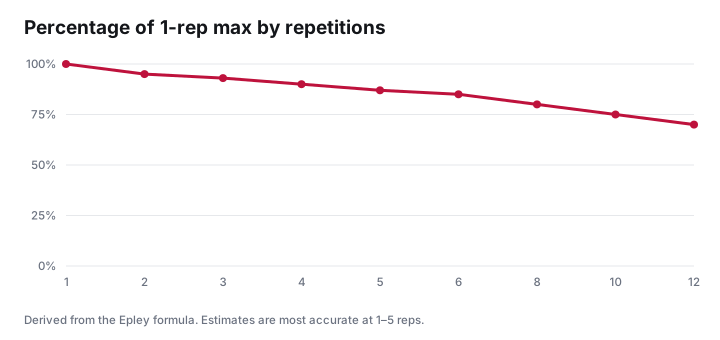
★ Highlighted formula is most accurate for your rep range. Formulas diverge above 10 reps.

Training percentages
% of 1RM Target weight Approx reps Training zone
How to use these percentages: Percentage-based training is the foundation of powerlifting periodization. Work in the 85–95% range for strength development, 70–80% for hypertrophy (muscle building), and 60–70% for speed-strength work. Most programs cycle between these zones over 4–12 week blocks.

Strength standards

Bench press — male (lb)
BodyweightBeginnerIntermediateAdvancedElite
135 lb95150205260
155 lb110175240310
175 lb125200275360
198 lb140225315405
220 lb155250350455
242 lb170270380500
Back squat — male (lb)
BodyweightBeginnerIntermediateAdvancedElite
135 lb125200290385
155 lb145235340455
175 lb165265385510
198 lb185300430575
220 lb205330475635
242 lb220355510685
Deadlift — male (lb)
BodyweightBeginnerIntermediateAdvancedElite
135 lb155250355465
155 lb180290415545
175 lb205330470620
198 lb230370530700
220 lb255410585775
242 lb275440630835

Female strength standards

Bench press — female (lb)
BodyweightBeginnerIntermediateAdvancedElite
97 lb4575110150
114 lb5590130175
132 lb65105150200
148 lb70115165220
165 lb75125180240
181 lb80135195260
Back squat — female (lb)
BodyweightBeginnerIntermediateAdvancedElite
97 lb65110165225
114 lb75130195265
132 lb90150220300
148 lb100165240325
165 lb110180260355
181 lb115195280380
Deadlift — female (lb)
BodyweightBeginnerIntermediateAdvancedElite
97 lb80140205280
114 lb95165240325
132 lb110190275370
148 lb120210300405
165 lb130225325435
181 lb140240345465

Training science

How to train each zone

💪 Max strength (90–100% 1RM)

1–3 reps per set. 3–5 minutes rest between sets. CNS-intensive — limit to 2–3 sessions per week per lift. This zone builds raw neural efficiency and motor unit recruitment. Used by powerlifters in peaking phases.

🔥 Strength (80–90% 1RM)

3–5 reps per set. 2–4 minutes rest. The primary strength development zone for most intermediate and advanced lifters. Programs like 5/3/1, Texas Method, and most powerlifting blocks operate primarily here.

📈 Hypertrophy (65–80% 1RM)

6–12 reps per set. 60–90 seconds rest (for metabolic stress) or 2–3 minutes (for mechanical tension). Most effective for muscle size gains. The primary zone for bodybuilding-style training.

⚡ Speed-strength (55–70% 1RM)

Move the bar as fast as possible for 3–6 reps. Used in Westside Barbell conjugate programming and athletic development. Develops rate of force development (RFD) — how quickly you can produce force.

🏃 Muscular endurance (50–65% 1RM)

15–25+ reps per set. Short rest periods (30–60 seconds). Builds work capacity and metabolic conditioning. Important for sport athletes but limited contribution to raw strength development.

🔬 Why 1RM testing matters

Your true 1RM is the foundation of percentage-based programming. Testing every 4–8 weeks allows accurate adjustment of training loads. Estimated 1RM from submaximal sets (this calculator) is the safest and most common method — true max testing carries higher injury risk.

Frequently asked questions
What is a good squat for my bodyweight?
As a general benchmark for men: squatting your bodyweight is a reasonable beginner milestone; 1.5× bodyweight is solid intermediate; 2× bodyweight is advanced; 2.5× is elite. For women, the benchmarks are roughly: 0.75× bodyweight beginner, 1.25× intermediate, 1.75× advanced, 2.25× elite. These ratios vary significantly by body proportions — taller lifters with longer femurs have a biomechanical disadvantage on the squat. The strength standards tables on this page provide more specific numbers by bodyweight category. Your only meaningful comparison is to your own previous performance.
How much should I be able to deadlift?
General benchmarks for men: 1.0× bodyweight is a beginner target; 1.5× is intermediate; 2.0× is advanced; 2.5× is elite. For women: 0.85× bodyweight beginner, 1.25× intermediate, 1.75× advanced, 2.25× elite. The deadlift has the least technique barrier of the three powerlifts — beginners can often pull respectable weight early. This makes the later learning curve steeper: getting from 2× to 2.5× bodyweight is dramatically harder than 1× to 1.5×. Use the strength standards tables above for specific numbers by bodyweight.
What is RPE in lifting and how does it relate to percentage?
RPE stands for Rate of Perceived Exertion — a scale from 1–10 describing how hard a set felt relative to your maximum. In powerlifting, RPE 10 means maximum effort with no reps left in reserve. RPE 9 means one rep left in the tank. RPE 8 is two reps left, and so on. The approximate relationship between RPE and percentage: RPE 10 ≈ 100% 1RM, RPE 9 ≈ 93–97%, RPE 8 ≈ 88–92%, RPE 7 ≈ 83–87%, RPE 6 ≈ 78–82%. These are approximations — individual lifters vary significantly. RPE-based programming (Juggernaut, RTS) is increasingly popular because it auto-regulates to daily readiness rather than fixing percentages regardless of how you feel.
What is a training max and how do I calculate it?
A training max (TM) is a reduced version of your true 1RM used as the basis for percentage calculations in programs like Jim Wendler's 5/3/1. The standard recommendation is to set your training max at 85–90% of your estimated true 1RM. The reason: training at percentages of a true 1RM leaves you grinding near-maximal weights every session, which is unsustainable. Using 85–90% as the basis means your "100%" training day still has a small buffer — keeping technique cleaner, reducing injury risk, and allowing consistent progress. Example: if your estimated 1RM is 300 lb, your training max would be 255–270 lb, and all program percentages are calculated from that number, not 300.
What is a Wilks score and what's a good one?
The Wilks score normalizes your total lifted weight relative to bodyweight, allowing fair comparison between lifters of different sizes. A Wilks score under 200 is novice; 200–300 is intermediate and competitive at local meets; 300–400 is advanced and competitive at regional/national levels; 400+ is elite; 500+ is world-record territory. The DOTS score has largely replaced Wilks in official competition (the IPF switched in 2020) because DOTS better accounts for heavier weight classes, but Wilks remains widely used for informal comparison.
How accurate is an estimated 1-rep max?
Estimated 1RM calculations are most accurate for sets of 1–5 reps, where all major formulas are within 2–5% of actual max. For sets of 6–10 reps, expect 5–10% variation. Above 10 reps, accuracy degrades significantly. Fatigue, bar speed, technique breakdown, and individual fiber type composition all affect accuracy. Use estimates as a planning guide, not a precise measurement. The Epley formula tends to be most accurate for sets of 1–5, while Brzycki is often cited for general use.
Should I actually test my 1-rep max?
For most intermediate lifters and below, there's rarely a need to actually test a true 1RM — the injury risk outweighs the benefit when you can estimate it accurately from a heavy set of 3–5. True 1RM testing makes sense for competitive powerlifters, coaches needing accurate programming data, and experienced lifters who have mastered technique under maximal load. If you do test, warm up thoroughly with progressively heavier singles and stop when the next attempt would be a miss. Never push to true failure without a qualified spotter or safeties in a rack.
What is a good bench press for my bodyweight?
For men: beginners press roughly 0.7× bodyweight; intermediate is 1.0–1.25×; advanced is 1.5–1.75×; elite exceeds 2×. For women: 0.5× beginner, 0.75× intermediate, 1.0× advanced, 1.35× elite. The bench press is the lift most affected by limb proportions — longer arms create a longer range of motion and mechanical disadvantage, so raw numbers between individuals with very different arm lengths aren't directly comparable. The strength standards tables above provide specific numbers by bodyweight.
What are the standard Olympic barbell plate sizes?
Standard Olympic plates (2-inch hole) come in: 45 lb, 35 lb, 25 lb, 10 lb, 5 lb, 2.5 lb, and 1.25 lb. In kilograms: 25kg, 20kg, 15kg, 10kg, 5kg, 2.5kg, 1.25kg, and 0.5kg. The IWF color standard: red for 25kg, blue for 20kg, yellow for 15kg, green for 10kg, white/grey for smaller plates. American powerlifting gyms typically use red for 45s, but there's no universal US standard. Always confirm actual plate weights at an unfamiliar gym — mislabeled plates are more common than you'd expect.
What percentage of my 1RM should I train at?
For maximum strength: train at 80–95% for low reps (1–5). For hypertrophy (muscle size): 65–80% for moderate reps (6–12). For work capacity: 50–65% for high reps (15–25+). Most effective programs cycle between these zones — a concept called periodization. The percentage table generated by this calculator gives you exact target weights for every meaningful percentage so you don't have to do the math at the gym.
Our methodology & sources

We don't invent numbers. Every estimate this calculator produces comes from a published, peer-reviewed formula, and we show our work so you can check it. When you enter a weight and rep count, we run it through six established one-rep-max equations and report the average:

In our own training we lean on the average of these rather than any single formula, because each one drifts in a different direction as reps climb — which is exactly why we average them. Our Wilks and DOTS scores use the official coefficient tables; note that the IPF adopted DOTS over Wilks for competition in 2020, so we report both. The strength-standards tables reflect commonly-cited bodyweight-ratio benchmarks and competition data, cross-referenced with resources from the NSCA and evidence-based coaching sources like Stronger By Science.

Estimates are most reliable at 1–5 reps and degrade above 10. They're a planning guide, not a guarantee — your true max depends on technique, fatigue, and individual physiology.

In-depth guides
Training resources
💪 Recommended gym equipment & supplements
Gear used by serious lifters — from barbells to chalk.

As an Amazon Associate and affiliate partner we may earn a commission on qualifying purchases and referrals at no additional cost to you.